
Peptide Stability in Various Solvents: What Laboratories Need to Consider During Reconstitution
How solvents, pH value, and temperature affect the stability of research peptides, and which reconstitution practices minimize degradation in the laboratory.
Dr. Lisa Weber
Scientific Editorial Department
M.Sc. Biochemistry, 8+ years of peptide research
A lyophilized peptide that remains stable in the refrigerator for months can lose measurable purity within just a few days after reconstitution. For laboratories working with research peptides, this discrepancy between dry and liquid stability is one of the most common sources of error when interpreting experimental results—an apparent lack of biological effect may simply be the result of an already degraded compound.
Which solvent is suitable for a specific peptide depends on its amino acid sequence, charge distribution, and tendency toward aggregation or oxidation. A blanket recommendation to "always use bacteriostatic water" falls short when sensitive residues such as methionine, cysteine, or tryptophan are present in the molecule.
This article summarizes the key physicochemical degradation mechanisms and derives practical criteria for solvent selection and storage in daily laboratory work.
Degradation Mechanisms of Peptides in Solution
In aqueous solution, peptides are essentially subject to two classes of degradation processes: chemical degradation (hydrolysis of peptide bonds, deamidation of asparagine and glutamine, oxidation of methionine and cysteine) and physical degradation (aggregation, fibril formation, adsorption to container surfaces). In their widely cited review article (Pharmaceutical Research, 2010), Manning, Chou, and Murphy provide a comprehensive overview of these mechanisms in protein and peptide pharmaceuticals, emphasizing that both degradation pathways frequently occur in parallel and influence one another.
Choice of Solvent
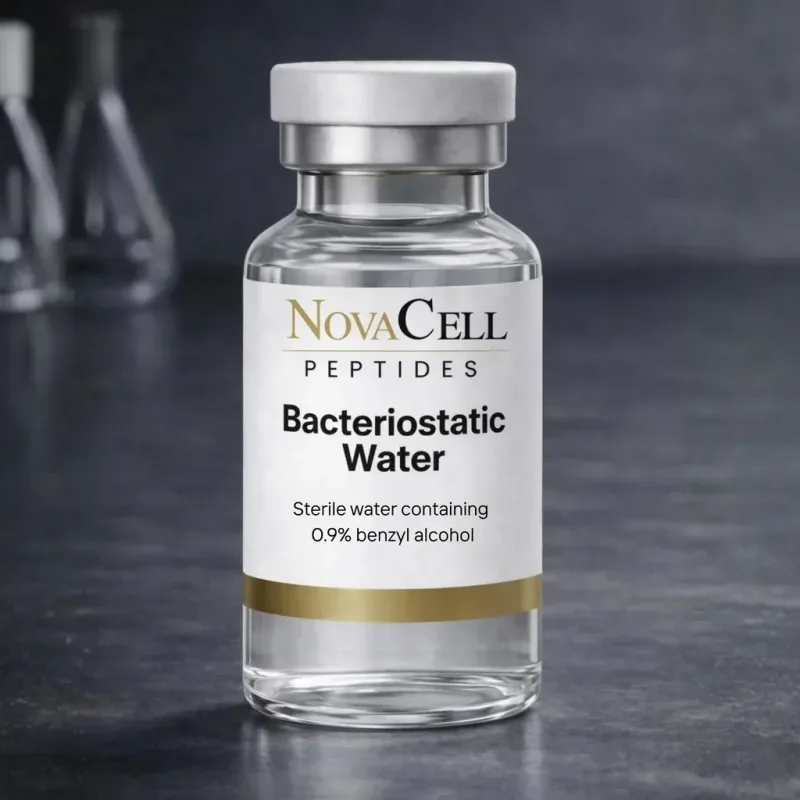
Pure, preservative-free water for injection minimizes chemical interactions but provides no microbial protection and is unsuitable for multiple withdrawals over several days. Bacteriostatic water containing benzyl alcohol extends the microbiological shelf life of an opened vial, but may slightly affect the chemical stability of certain peptides—particularly those with free amino groups. Solvents containing acetic acid are used specifically in research for poorly soluble, strongly basic peptides to prevent aggregation via electrostatic repulsion.
Influence of pH Value on Stability
The pH value of the reconstitution solution significantly affects both the hydrolysis rate and the propensity for aggregation. In an early systematic study (Pharmaceutical Research, 1991), Powell and colleagues demonstrated for a range of peptide hormones that the rate of hydrolysis exhibits a U-shaped minimum depending on pH, the exact position of which strongly depends on the specific sequence. For many research peptides, this stability optimum lies in the weakly acidic to neutral range, explaining the common practice of dissolving sensitive peptides in slightly acidified rather than pure neutral water.
Temperature, Storage, and Freeze-Thaw Cycles
After reconstitution, peptide solutions should be consistently refrigerated (2–8 °C) and protected from light; for longer storage periods, aliquoting and freezing at −20 °C or lower is standard. Repeated freeze-thaw cycles promote aggregation and local concentration spikes at the ice-water interface. In International Journal of Pharmaceutics (1999), Wang describes in detail how formulation factors and storage conditions interact in liquid protein and peptide preparations, and how aliquoting strategies reduce the number of harmful thaw cycles per sample.
Peptide-Specific Characteristics
Not every peptide behaves the same way in solution. A few practically relevant examples:
- Copper-containing peptides such as GHK-Cu may exhibit ligand exchange reactions if the wrong solvent is selected, weakening copper binding
- Peptides with disulfide bonds (e.g., Melanotan-1/2) are sensitive to oxidative or strongly reducing conditions in the solvent
- Small, highly hydrophobic fragments tend to adsorb to glass and plastic surfaces regardless of solvent, which can be mitigated using carrier proteins or specialized low-bind vessels
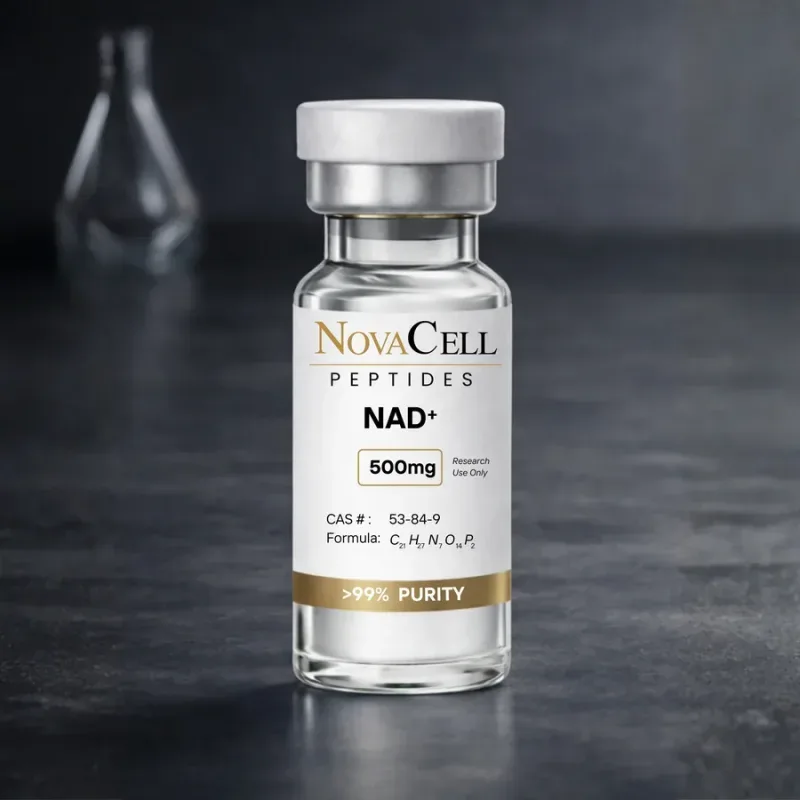
- NAD+ is chemically not a classic peptide, but likewise exhibits pronounced pH and temperature dependence regarding its stability in solution
Comparison of Common Solvents
| Solvent | Microbiological Protection | Typical Application | Points to Consider |
|---|---|---|---|
| Water for Injection | None | Immediate use, single experiment | Short shelf life after opening |
| Bacteriostatic Water | Yes (benzyl alcohol) | Multiple withdrawals over days/weeks | Not chemically neutral for all peptides |
| Diluted Acetic Acid | None | Poorly soluble, basic peptides | Immediate use recommended |
| Sterile 0.9% NaCl | None | Isotonic applications in cell culture | Ionic strength can promote aggregation |
Analytical Control of Stability
Reliable statements regarding the stability of a specific batch can only be made through analytical testing, not empirical values alone. HPLC purity determinations before and after defined storage periods, as well as LC-MS testing for degradation products, belong in a robust stability protocol. In Pharmaceutical Research (2003), Chi and colleagues discuss suitable analytical methods for detecting aggregation and chemical degradation in aqueous peptide and protein solutions, emphasizing the necessity of orthogonal methods, as individual procedures detect different degradation products with varying sensitivity.
Implications for Laboratory Practice
For routine laboratory practice, a simple rule can be derived from this: reconstitution protocol, solvent, storage conditions, and sampling frequency should be documented for each peptide class and, if necessary, verified through in-house stability testing rather than uncritically adopting generalized manufacturer statements. Where a batch COA is available, it provides at least the baseline state against which subsequent purity losses can be measured.
RUO Notice: The mentioned peptides are offered by NovaCell exclusively as research products (Research Use Only) for use in cell culture and animal experimental studies. They are not intended for human use, diagnostic purposes, or as pharmaceuticals.
Related Products
Checkout policy at a glance
- Shipping
- EU warehouse (Poland) for the EU countries we serve, Dubai warehouse (DAD) for UAE. Free shipping from 115 EUR order value before discount; otherwise from 12.99 EUR depending on destination. No shipping outside these regions.
- Bank transfer (NCBL Sciences OÜ)
- SEPA / IBAN via NCBL Sciences OÜ (Estonia/Lithuania). Tip: for Revolut use the LT IBAN. Payment window 3 business days.
- Crypto (NOWPayments)
- BTC, ETH, USDT and others via NOWPayments. 3 % discount when paying with crypto. No card payments.
Related articles
Deepen your RUO knowledge with curated follow-up reading.
RUO vs. GMP: What Actually Makes the Difference in Peptide Production
Comparing RUO and GMP: Which requirements actually apply to documentation, purity, and quality assurance for research peptides, and where the boundaries lie.
Buying Peptides in Europe 2026: Tesamorelin and Triple-G in Research
Tesamorelin and Triple-G as research peptides: procurement, customs, COA documentation, and supplier selection for European laboratories in 2026.
GLP-5 in Research: What Laboratories Should Check Before Working With It
What the name GLP-5 does and does not tell you, which analytical data a complex research peptide needs and how to plan experiments around a single batch.
Further Resources
Legal Disclaimer
All content is for scientific and informational purposes only. The information presented is based on current research literature and should not be construed as medical advice.
No product is intended for human or animal consumption.