Cannot be combined with discount codes.
Buying Peptides in Europe 2026: Tesamorelin and Triple-G in Research
Tesamorelin and Triple-G as research peptides: procurement, customs, COA documentation, and supplier selection for European laboratories in 2026.
Dr. Lisa Weber
Scientific Editorial Board
M.Sc. Biochemistry, 8+ Years of Peptide Research
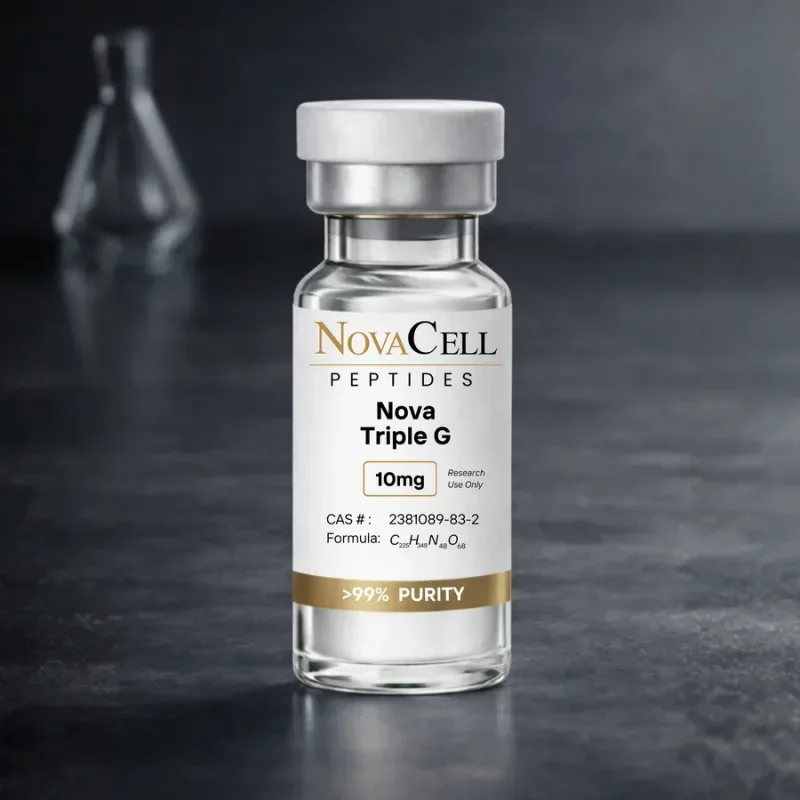
Interest from European laboratories in research peptides targeting the metabolic and somatotropic axes has grown steadily, with two substances coming into focus in 2026: Tesamorelin, a long-established GHRH analogue, and Triple-G, a triple agonist peptide designated by NovaCell that simultaneously activates multiple metabolic receptors. Both are valuable tools in cell culture and rodent models, but procuring them for a European laboratory requires careful documentation and a thorough understanding of the practical implications of Research Use Only (RUO) status.
At the same time, the peptide market is fragmented: the same synthesis batch may end up under various brands, and purity claims vary from supplier to supplier without providing actual batch analytics. For a laboratory requiring reproducible results, marketing copy is irrelevant; what matters is verifiable batch identification and documented purity.
This article examines the research background of Tesamorelin and Triple-G, the practical conditions for European procurement, and the criteria for selecting a supplier in 2026.
Why Tesamorelin and Triple-G Interest Research Groups in 2026
Tesamorelin and Triple-G represent two different approaches to receptor systems key to metabolic research. Tesamorelin acts via the GHRH receptor and has served as a benchmark in studying growth hormone axis regulation for years. Triple-G, on the other hand, represents a newer class of peptides where a single molecule simultaneously activates multiple receptors—an approach that has drawn widespread interest in metabolic research since Coskun and colleagues described the receptor profile of a similar triple agonist in cell culture models (Coskun et al., Cell Metabolism, 2022).
Tesamorelin: Mechanism of Action of a GHRH Analogue in Preclinical Models
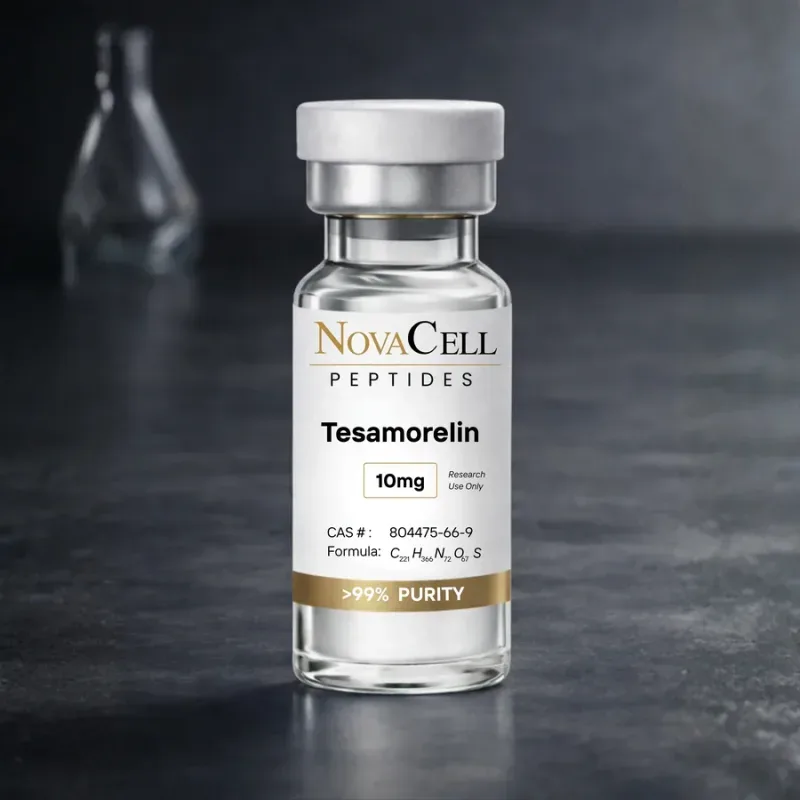
Tesamorelin is a synthetic analogue of human GHRH(1-44) hormone, modified with a trans-3-hexenoic acid group at the N-terminal end. This modification retards enzymatic degradation by DPP-4 and extends the molecule's half-life compared to native GHRH. At the receptor level, Tesamorelin binds to the GHRH receptor on somatotropic cells in the anterior pituitary gland and stimulates pulsatile growth hormone release, a mechanism distinct from secretagogues acting via the ghrelin receptor, such as Ipamorelin.
In vitro stability assays in human plasma have demonstrated that slowed DPP-4-mediated cleavage translates into measurably enhanced stability of the intact sequence over time—an observation replicated in multiple internal laboratory comparative trials.
Much of the molecular understanding of Tesamorelin relies on published research data, which is discussed here solely as a source of scientific information. Falutz and colleagues reported in the New England Journal of Medicine on the metabolic effects of growth hormone-releasing factor in the studied population (Falutz et al., New England Journal of Medicine, 2007). NovaCell's RUO research reagent is restricted in its use to cell and animal models.
Triple-G: Research Background of a Triple Agonist Peptide
NovaCell's reference peptide designated as Triple-G belongs to a peptide class built upon a GIP receptor backbone, incorporating targeted substitutions that additionally activate the GLP-1 receptor (GLP-1R) and the glucagon receptor (GCGR). Compared to dual agonists that target only two of these receptors, a third binding site increases the structural complexity of the molecule and consequently the number of synthetic steps where errors can occur.
The structure—comprising approximately 40 amino acids and an attached fatty acid chain—imposes significantly higher demands on synthesis and purification than shorter secretagogues. Therefore, simple HPLC area percentage is insufficient to prove the true composition of a batch; mass spectrometric identification is also required.
Typical sources of error in synthesizing peptides of this size include incomplete amino acid chain elongation, deficient attachment of the fatty acid linker, and the formation of diastereomers at non-proteinogenic structural elements. Each of these deviations measurably alters the molecular mass, but may not be resolved by simple HPLC area percentage if the byproduct's retention time closely mirrors that of the target molecule.
Procurement in Europe: RUO Status, Customs, and Documentation
When importing into the European Union, a research peptide's RUO designation serves as an intended use specification, keeping the substance outside the scope of pharmaceutical legislation as long as the product is clearly and consistently labeled and marketed for research use. Regarding chemical legislation, the REACH Regulation (Regulation (EC) No 1907/2006) and the CLP Regulation (Regulation (EC) No 1272/2008) define obligations concerning Safety Data Sheets (SDS), whereas Directive 2001/83/EC on medicinal products for human use becomes applicable only if the presentation or actual use indicates a medicinal purpose. At customs, alongside product classification, the actual intended use of the shipment is increasingly inspected; therefore, laboratories should keep an invoice, COA certificate, and, if applicable, a Safety Data Sheet readily available for every order.
- An invoice explicitly marking the product for research use (RUO)
- A batch-specific Certificate of Analysis (COA)
- A Safety Data Sheet if the substance is classified as hazardous
- A clear link to the purchase order and the laboratory's research project
COA and Purity: What to Pay Attention To
For longer, structurally complex peptides like both Tesamorelin and Triple-G, a simple HPLC area percentage tells only part of the story. A reliable COA separately reports measured and theoretical molecular mass (LC-MS), HPLC purity along with the analytical method and wavelength used, counter-ion content (typically TFA or acetate), and water content determined via Karl-Fischer titration. Together, these parameters reveal how much of the weighed lyophilisate is actually active peptide.
For batches intended for use in animal models, the endotoxin level should also be verified separately, as bacterial endotoxins even in low concentrations can trigger an inflammatory response that confounds experimental interpretation regardless of the peptide's chemical purity. The standard method for this is the Limulus Amebocyte Lysate (LAL) assay, the results of which should systematically be requested as part of the COA documentation for systemically administered batches.
Supplier Selection Criteria in 2026
| Criterion | Reliable Supplier | High-Risk Supplier |
|---|---|---|
| COA | Batch-specific, dated, confirmed by mass spectrometry | Generic, reused certificate |
| Labeling | Clear RUO labeling, no human dosage instructions | Human user experiences, ambiguous intended use |
| Shipping | Documented cold chain if necessary | No information on transport conditions |
| Price | At market level, justified by analytical costs | Significantly below market price without justification |
Beyond these hard criteria, it is advisable to request a sample COA from a previous batch prior to placing an initial order. This allows you to evaluate whether analytics are applied consistently from batch to batch or if measurement methods and reporting styles vary between orders—a detail easily overlooked by merely reviewing a product page.
Storage and Transport in Europe
Lyophilized peptides remain stable at room temperature for a limited time, but moisture, light, and repeated temperature fluctuations compromise stability. Thermal insulation during shipping is particularly critical during summer months, and upon arrival, the material should be stored frozen and protected from light. Following reconstitution, aliquoting into small working volumes is recommended to avoid repeated freeze-thaw cycles over extended experimental series.
Summary for Laboratory Practice
When procuring both Tesamorelin and Triple-G for a European laboratory, it is essential to distinguish between two aspects: the scientific background of the substance and the documentation supporting its procurement. Published literature provides a solid foundation for understanding mechanisms, but each batch must be evaluated independently based on its own COA. By consistently documenting purchase orders, analysis certificates, and intended use, a laboratory can ensure the reproducibility of experimental series while demonstrating compliance for research use during potential audits.
RUO Notice: All substances mentioned in this article are intended strictly for research in cell and animal models (Research Use Only). Products are not approved as pharmaceuticals, are not intended for human use, and no dosing recommendations are provided for human administration.
Related Products
Checkout policy at a glance
- Shipping
- EU warehouse (Poland) for the EU countries we serve, Dubai warehouse (DAD) for UAE. Free shipping from 115 EUR order value before discount; otherwise from 12.99 EUR depending on destination. No shipping outside these regions.
- Bank transfer (NCBL Sciences OÜ)
- SEPA / IBAN via NCBL Sciences OÜ (Estonia/Lithuania). Tip: for Revolut use the LT IBAN. Payment window 3 business days.
- Crypto (NOWPayments)
- BTC, ETH, USDT and others via NOWPayments. 3 % discount when paying with crypto. No card payments.
Related articles
Deepen your RUO knowledge with curated follow-up reading.
Retatrutide as a Research Peptide: The GIP/GLP-1/Glucagon Tri-Agonist for EU Laboratories
Retatrutide as a GIP/GLP-1/glucagon tri-agonist for research: mechanism of action, HPLC purity, COA certificate, and the RUO framework for purchasing in the EU.
Buying Peptides in Germany: 7 Criteria for a Reputable Laboratory Supplier in 2026
Seven concrete criteria that laboratories in Germany can use in 2026 to distinguish a reputable supplier of research peptides from an unreliable one.
RUO vs. GMP: What Actually Makes the Difference in Peptide Production
Comparing RUO and GMP: Which requirements actually apply to documentation, purity, and quality assurance for research peptides, and where the boundaries lie.
Further Resources
Legal Disclaimer
All content is for scientific and informational purposes only. The information presented is based on current research literature and should not be construed as medical advice.
No product is intended for human or animal consumption.