
GLP-5 in Research: What Laboratories Should Check Before Working With It
What the name GLP-5 does and does not tell you, which analytical data a complex research peptide needs and how to plan experiments around a single batch.
NovaCell Science Team
Expert Editorial
What the name "GLP-5" does and does not tell you
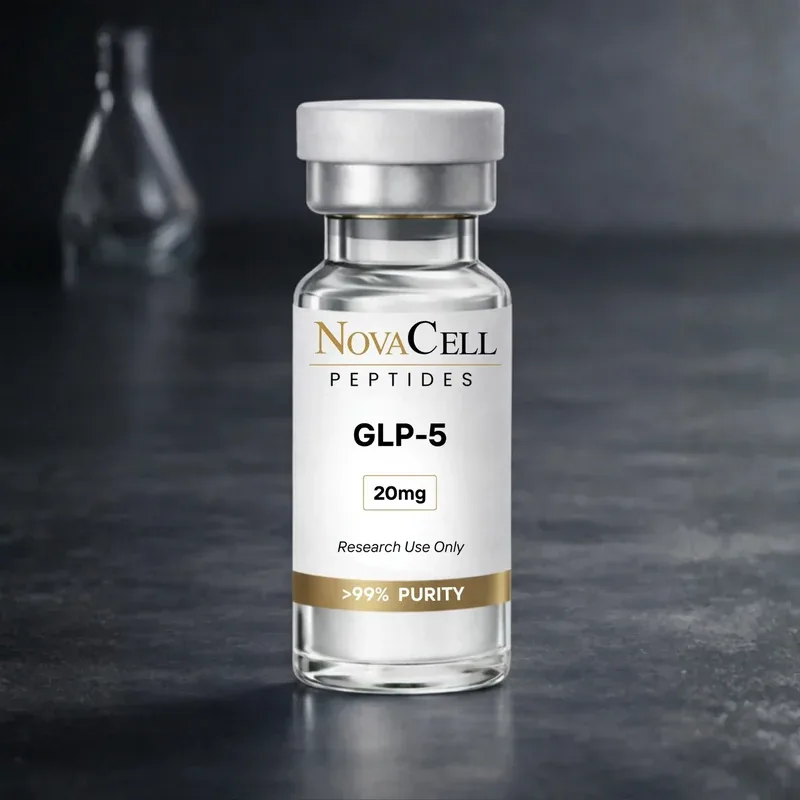
Product names in the research-peptide field are often shorthand rather than systematic nomenclature. A name such as "GLP-5" signals that a material belongs to the broad field of metabolic peptide research, but it is not a pharmacological classification and says nothing verified about mechanism, potency or selectivity. For laboratory work, the reliable starting point is therefore not the name but the documentation of the specific batch: identity, purity, net peptide content and lot number. Any assumption about how a material behaves in a given assay should be established experimentally in your own model, with appropriate controls.
Why complex research peptides demand more from analytics
Longer and more elaborately modified peptides offer more opportunities for synthesis by-products: truncated sequences, deletion variants, incompletely deprotected or oxidised residues. Some of these impurities elute close to the main peak and can only be told apart with suitable chromatographic methods and mass-spectrometric confirmation. The more complex the molecule, the more important it is to read the analytical data carefully instead of relying on a single purity figure.
Identity, purity and content: the analytical minimum
For a complex research peptide, laboratories should look for at least the following information per batch:
- an HPLC chromatogram showing the main peak and the relevant impurity profile;
- LC-MS confirmation that the measured mass matches the expected molecular mass;
- a clear batch or lot number that links the vial to its analytical data;
- information on net peptide content, because counter-ions and residual moisture mean that the weighed amount is not the same as the amount of peptide.
Planning experiments around a limited batch
Materials released in small first batches call for particular care in study design:
- plan the complete experimental series in advance, so that all comparisons are run with material from the same lot;
- include vehicle and reference controls from your own validated assay set-up;
- record the lot number in the lab notebook for every experiment;
- begin with characterisation in your own in-vitro system before any more extensive work.
Documentation and traceability
Reproducible research depends on being able to trace every result back to the material used. Keep analytical data, delivery documents and lot numbers together with your raw data. If results from different batches have to be compared, state this explicitly and treat differences between lots as a variable in their own right.
Outlook
New names will keep appearing as peptide research evolves. For laboratories, the sensible approach stays the same: treat each new material as uncharacterised until your own data and the batch documentation support specific conclusions, and build findings step by step, with clean controls and full traceability. RUO notice: All peptides referenced in this article are supplied strictly for scientific research (Research Use Only). They are not intended for human or veterinary use, are not medicinal products, and this article contains no dosing recommendation.
Related Products

Checkout policy at a glance
- Shipping
- EU warehouse (Poland) for the EU countries we serve, Dubai warehouse (DAD) for UAE. Free shipping from 115 EUR order value before discount; otherwise from 12.99 EUR depending on destination. No shipping outside these regions.
- Bank transfer (NCBL Sciences OÜ)
- SEPA / IBAN via NCBL Sciences OÜ (Estonia/Lithuania). Tip: for Revolut use the LT IBAN. Payment window 3 business days.
- Crypto (NOWPayments)
- BTC, ETH, USDT and others via NOWPayments. 3 % discount when paying with crypto. No card payments.
Related articles
Deepen your RUO knowledge with curated follow-up reading.
RUO vs. GMP: What Actually Makes the Difference in Peptide Production
Comparing RUO and GMP: Which requirements actually apply to documentation, purity, and quality assurance for research peptides, and where the boundaries lie.
Peptide Stability in Various Solvents: What Laboratories Need to Consider During Reconstitution
How solvents, pH value, and temperature affect the stability of research peptides, and which reconstitution practices minimize degradation in the laboratory.
Buying Peptides in Europe 2026: Tesamorelin and Triple-G in Research
Tesamorelin and Triple-G as research peptides: procurement, customs, COA documentation, and supplier selection for European laboratories in 2026.
Further Resources
Legal Disclaimer
All content is for scientific and informational purposes only. The information presented is based on current research literature and should not be construed as medical advice.
No product is intended for human or animal consumption.